Why Course Completion Rates Don't Prove Workforce Capability

Updated: Aug 28
"We hit 94% completion this quarter."
An L&D head said this to me recently, genuinely pleased. Then her chief executive asked whether escalations had dropped. Silence.
That silence is the most honest moment in most L&D reviews. Completion is the easiest number to report and the least revealing one.
It confirms that people clicked through a module. It says nothing about whether a first-time manager can now hold a difficult conversation, whether a delivery lead writes an email a client actually understands, or whether a shop-floor handover stopped losing information.
This post looks at why completion and workforce capability are two different things, what to measure instead, and how to close the gap between the two.
Completion rates prove people clicked through a module, not that they can do the job. Capability is what changes on the floor: fewer escalations, clearer emails, cleaner handovers. Measure the behaviour, not the attendance.
What do course completion rates actually measure?
A completion rate tells you someone finished. It does not tell you they changed.
We see the same pattern across BFSI, IT services, pharma, and manufacturing. The dashboard is green. The behaviour on the ground has not moved. Nobody notices until a client complains or an escalation lands on someone senior enough to ask why.
This is not a motivation problem, and it is rarely a content problem. It is a measurement problem. When the only signal you track is whether a course was finished, you optimise for finishing courses. You do not optimise for the thing the training was meant to change.
The skills gap is real, but training volume isn't closing it
The scale of the underlying challenge is well documented. In a McKinsey Global Survey conducted in May 2019, 44 percent of respondents said their organisations would face skill gaps within the next five years, and another 43 percent reported existing skill gaps.
Together, that is 87 percent saying they either were experiencing gaps already or expected them within a few years.
McKinsey & Company
That figure gets quoted often, usually as proof that organisations should train more. It is worth reading more carefully. In the same survey, fewer than half of respondents had a clear sense of how to address the problem.
The gap was never only about volume of training. It was about knowing which capabilities were missing and whether any intervention actually built them. More completed modules do not answer either question.
What is the difference between competency and capability?
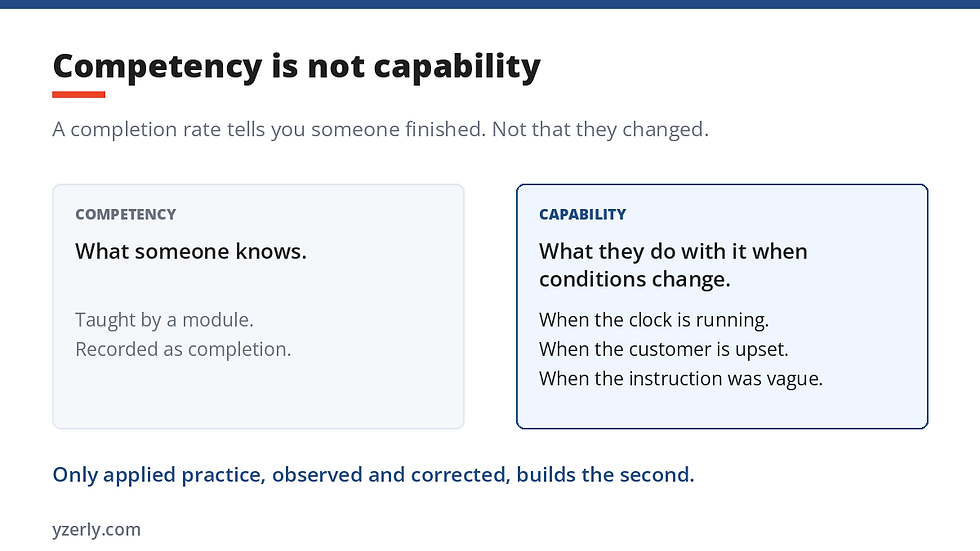
Here is the distinction that matters. Competency is what someone knows. Capability is what they do with it when conditions change: when the service level clock is running, when the customer is upset, when the instruction was ambiguous and the deadline was not.
A module can teach the knowledge. Only applied practice, observed and corrected, builds the capability. And only the second one shows up in your CSAT, your turnaround time, your escalation count, your first-contact resolution. Those numbers move when behaviour moves, not when a progress bar reaches 100 percent.
What should you measure instead of completion rates?
If completion is a weak proxy, what is a stronger one? Four shifts help.
Baseline before you begin. Run a diagnostic that establishes what people can currently do, not what they have attended. Without a baseline, you cannot claim improvement honestly.
Measure behaviour, not attendance. Define the specific behaviours the programme should change, then observe them through manager validation, work-sample review, or call and email audits.
Tie the intervention to a business metric. Pick the number the training is meant to move, agreed with the business before you start, and track it pre, mid, and post.
Validate through the manager, not the learner. Self-reported confidence is not evidence. A manager confirming a changed behaviour on the floor is.
None of this requires abandoning your learning platform. It requires refusing to let the platform's completion figure stand in for proof.
Three things to remember:
Completion measures activity, not ability.
Capability shows up in business signals: escalations, CSAT, rework.
Benchmark before and after, or you are guessing.
The question worth sitting with
Completion rates survive because they are easy, not because they are useful. They give everyone something green to point at while the metric that actually costs money stays flat.
So the uncomfortable question for anyone signing off an L&D budget this year: if every course was completed and no business metric moved, what did you actually buy?
If you are not sure how you would answer that, a capability diagnostic is a reasonable place to start. It tells you where your teams stand today, so the next programme can prove it changed something.
Written by Mahesh Tharani. Connect on LinkedIn.


Comments